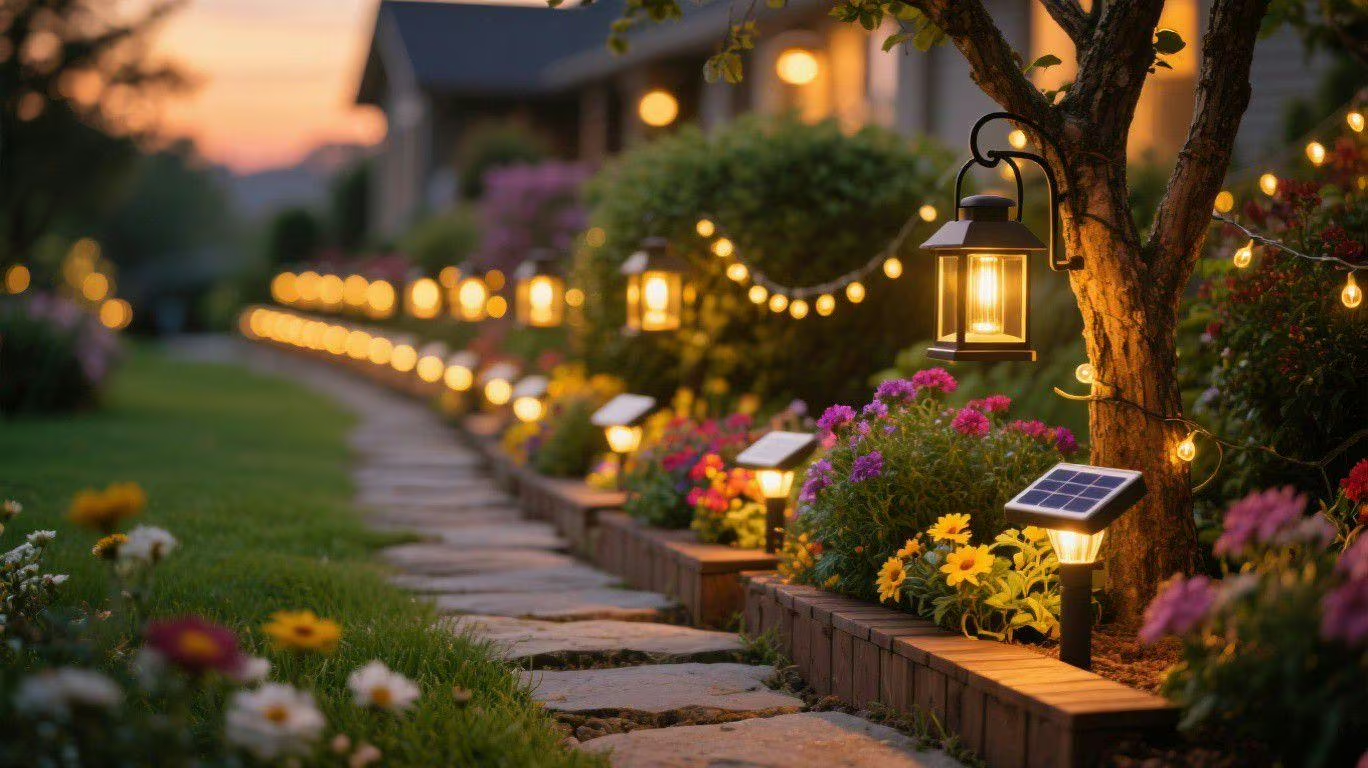
My father-in-law handed me two path lights he was tired of, a warm set from one store and a slightly different warm set from another, and told me to do whatever I wanted with them. I stuck them in the ground next to my own three, stood back at dusk, and realized my front yard now contained three subtly different color temperatures and, somehow, four different design decades. It looked like three neighbors sharing one lawn.
The Warm-Only Rule
The fix was a rule, not a shopping spree. Everything that lights up outside stays between roughly 2700 and 3000 Kelvin, the warm white range, and nothing cooler is allowed to plug into this yard. That was three years ago. The yard has fewer arguments in it now, because color temperature turns out to be the loudest thing about a lit landscape. Two fixtures of identical brightness but different warmth will fight all night, while two wildly different fixtures at the same warmth will get along. If you want the full reasoning, our piece on warm white versus cool white covers what each range does to siding, plants, and skin.
The audit that started it all took one evening. I walked the yard at dusk with a piece of paper and wrote down every fixture and what it looked like: warm, cool, or question mark. The question marks were the real problem, mostly older fixtures whose output had drifted as their lenses yellowed with age. If a light could not be identified as warm by standing it next to a known warm one, it went on the replacement list, and the list became a plan instead of a vague guilt.
How One Temperature Tames Mismatched Fixtures
Most yards are collected, not designed. A house number light from one era, path lights from a sale, a motion flood from the hardware store, a gift. Nobody plans for them to match, and they never do. The warm-only rule quietly retires that problem, because once every light is the same color, differences in shape start reading as character instead of chaos.
The practical version is even cheaper than it sounds. You do not replace everything at once. You replace on failure, which for solar lights usually means batteries first and fixtures second, and every replacement is warm. When I finally consolidated the front walk into a single multi-pack of warm path lights, four old mismatched heads moved to the side yard where nobody judges, and the front went coherent in one afternoon.
Warm only does one more job nobody advertises: it makes brightness planning easier. When every fixture shares a color, differences in output stop reading as mistakes and start reading as layers. Dim lights low along the path, medium ones at eye level, and one bright burst saved for the motion light at the drive. Layered light at a single temperature looks deliberate at any budget, which is the entire secret of yards that look designed without being expensive.
Strings Count Too
The rule only works if it includes the fun lights. A cool-white string over the patio will undo an hour of warm discipline everywhere else, so choose warm white string lights even for casual summer evenings, and the whole property keeps telling one story.
Shopping is where the rule gets tested, because packaging lies by omission. Anything labeled daylight or bright white is cool, no matter how snowy the photo on the box. Look for a stated Kelvin number, 2700 or 3000, and treat anything above 4000 as a parking-lot fixture that wandered into a catalog. Solar fixtures with a fixed warm LED make the whole question easy, since there is no mode to bump by accident in July and forget until December.
When I Break My Own Rule
Two exceptions, and only two. December gets color, because holidays are supposed to break the everyday look, and the warm backbone underneath actually makes the colored strands look better. And a small amber flame effect counts as warm enough for me, since it is a texture within the family rather than a departure. Everything else stays in line.
A year after the father-in-law handoff, a neighbor asked who did our lighting. Nobody did. We just stopped letting the fixtures argue about color, and the yard finally sounds like one person talking.
The two hand-me-down heads still light the side yard, by the way, warm as anything, three years into their second career.