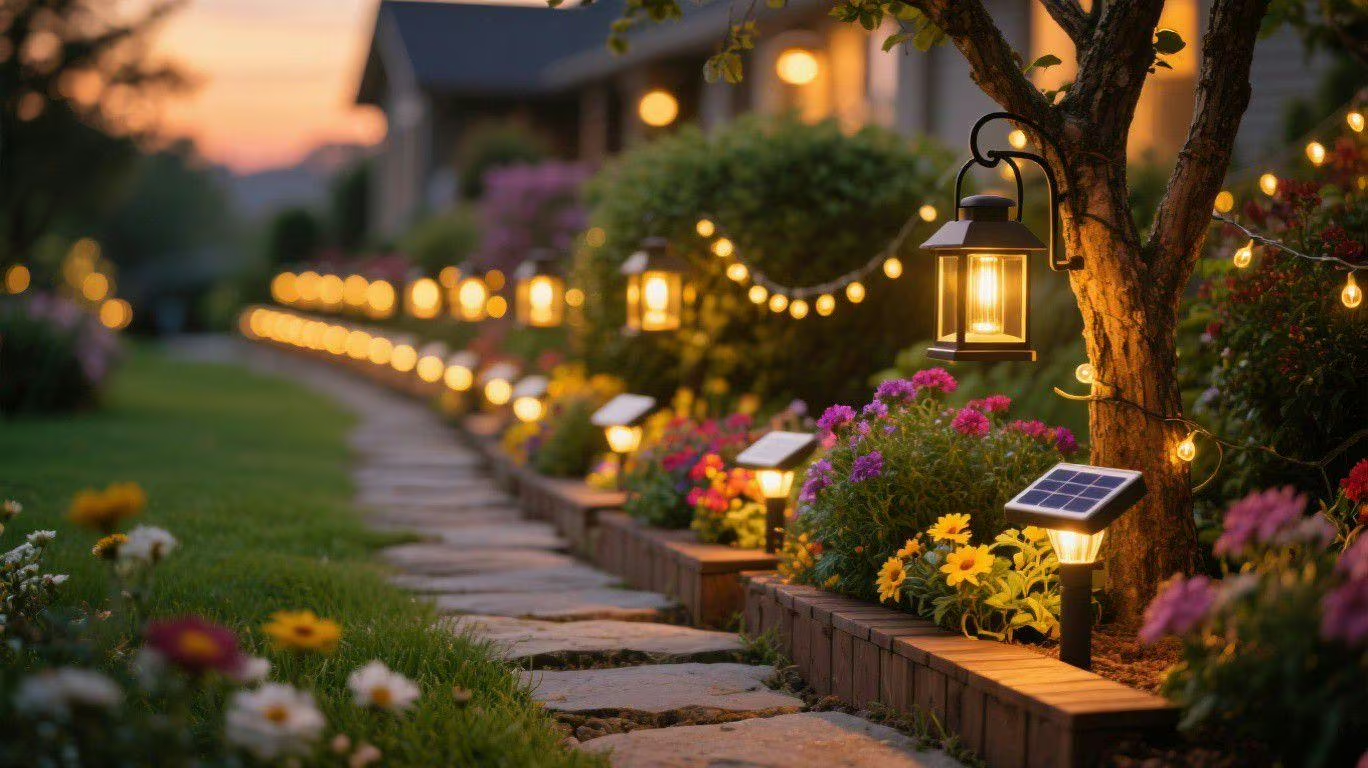
Last January I walked up a neighbor’s newly upgraded front path, thirty bright fixtures strung out like runway markers, and halfway along I realized I could see less than on my own walkway, which runs about a fifth as many lights. Every step was glare. The snow had turned each head into a little sun, and my eyes spent the whole walk recovering from the previous fixture instead of watching my feet. That path had roughly tripled its lumen count and gotten worse at its only job.
Why Winter Is a Different Brightness Problem
Two things change in winter. First, the traffic: the sun sets before 5 p.m. after the clocks fall back, so the path gets used in full darkness every single evening instead of only at party time. Second, the surface: snow and ice reflect light straight back up, which means every lumen aimed at a white path hits your eyes twice. Meanwhile older eyes handle glare worse, so the household members who most need a lit path are the ones most punished by a bright one.
Snow also changes what the light is for. In summer a path light mostly sets a mood for people strolling slowly. In winter the same fixture is infrastructure, guiding someone carrying groceries across ice in gloves and boots. The needs are almost opposite: ambience rewards warmth and restraint, while safety rewards consistency, a clear pool of light exactly where the foot goes, every single step.
Lumen Bands That Work in Winter
I think of winter brightness in bands rather than exact numbers, and I hold them loosely, because beam angle and mounting height matter as much as raw output. For path lights, something in the modest double-digit range per fixture, roughly 20 to 50 lumens, marks a route through snow perfectly well. For step lights, go lower still, in the 10-to-25 neighborhood, because a step needs its edge defined, not lit like a stage. For the entry, stop thinking constant glow entirely and let a motion fixture deliver a big burst of several hundred lumens for the ten seconds anyone actually needs it. We walk through how these numbers relate to watts and to real fixtures in our lumens versus watts explainer.
If you want the shorthand: in summer, buy for ambience, and in winter, buy for orientation. A solar pathway light set that felt merely adequate in July is usually still correct in January, while the fixture that felt impressive in July is the one blinding you in January.
Why More Lumens Make Snow Worse
Brightness on snow is a subtraction problem. Your eyes adjust to the brightest thing in view, so every overpowered head resets your night vision downward, and the pools between fixtures get darker by comparison, not lighter. The result is exactly what my neighbor built: thirty sources of glare with invisible gaps between them. Shielded heads, warm color, and wider spacing beat raw output every time, because they spread adaptation evenly along the whole run.
Color plays a role too. Warm light reflects off snow more softly than cool blue-white, which reads harsher and makes ice patches glare. If your current set is cool white and the path feels aggressive in January, that is not your imagination. Warm heads at the same output feel calmer on the eye and still mark the route just as clearly.
The Fix for a Runway Path
You rarely need to buy anything to repair an overbright winter walk. Drop every fixture to its lowest mode, or dim mode if the set has one. Widen the spacing so pools of light just overlap at ground level. Swap any cool-white heads to warm, since warm light glares less off ice. Then cover the two or three worst offenders for a night and see if the path actually got easier to walk. On my neighbor’s path, the eventual answer was running half the fixtures in dim mode, and it went from runway to sidewalk in one evening.
For steps, keep the same instincts and go even gentler: a low-output stair light at each riser beats one bright spot on the landing, because the edge you need to see is the one right under your foot, not the one ten feet ahead.
For a short walk, four dim fixtures with even spacing will outperform eight bright ones every night of the winter. Count what you have before you buy anything, because the fix is usually spacing and mode, not budget.