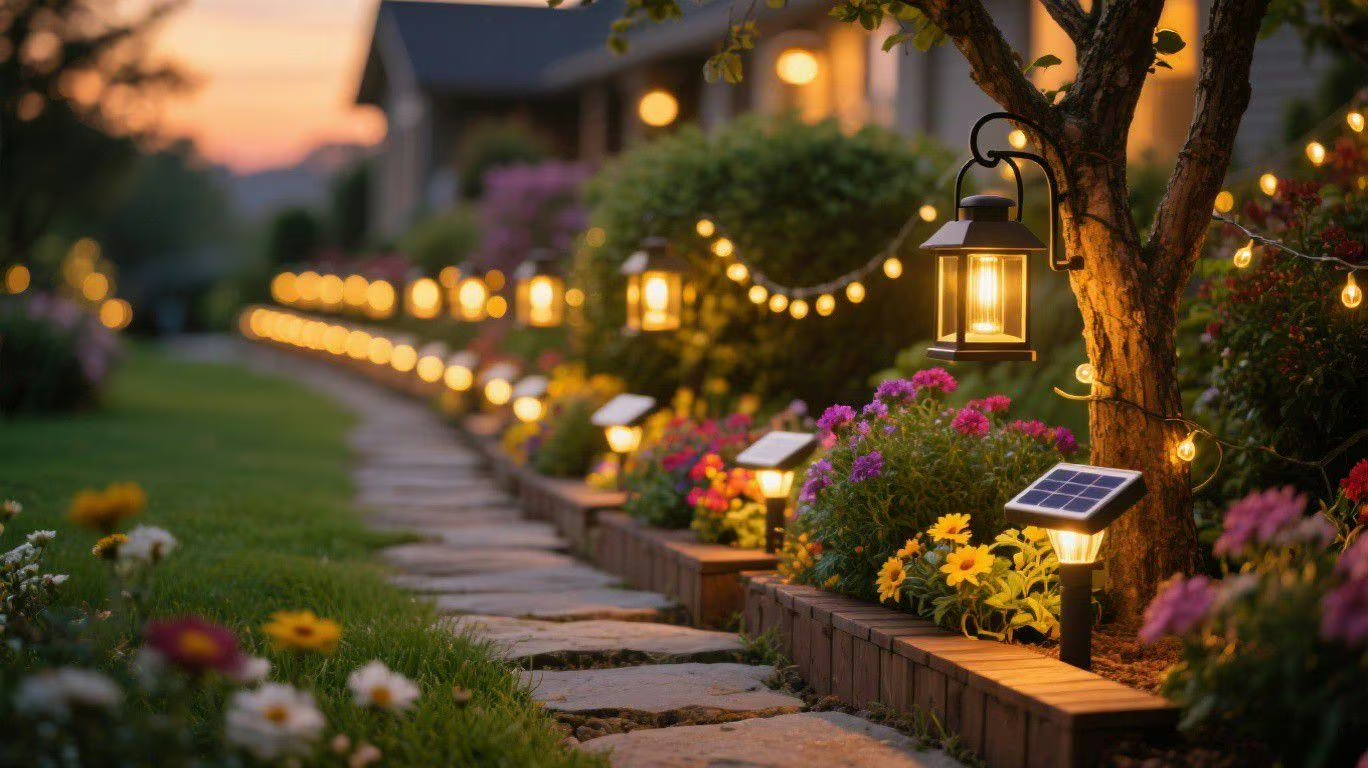
Every December, somewhere in every neighborhood, a person carries an extension cord across a frozen lawn in the dark, trips over a sprinkler head, and starts rethinking their whole holiday. Take this as the warning it is: most Christmas lighting misery is an outlet problem wearing a costume, and most outlets are in the wrong place. Solar strings sidestep all of it, no ladder against icy gutters, no cords through window gaps, no timers to reset. But only if you point them at the right parts of the yard.
Where Solar Genuinely Replaces Plug-In
Bushes and shrubs are the perfect solar job. A set of solar string lights wraps onto an evergreen in minutes, with the panel staked nearby in whatever sun exists, and the bush glows every night without a single cord crossing the yard. Foundation plantings, island beds in the lawn, the mailbox, the far fence: anywhere that is forty feet from the nearest outlet is exactly where solar stops being the compromise option and becomes the obvious one.
Fence lines and railings are the second sweet spot. Flame-effect string lights along a porch rail or a low fence give the whole display a warm, moving centerpiece, and because solar strings carry their own power, you can run them along sections that wired lights could never reach without a hundred feet of cord.
The mailbox deserves special mention, because it is the single most solar-friendly spot on most properties: wide open to the sky, far from the house, and impossible to reach with a cord without crossing the lawn. A wrapped mailbox post with a staked panel nearby reads from the street as effort and care, when it actually took ten minutes and zero wiring.
Where Solar Still Cannot Compete
Dense rooflines. Be honest about this before buying. A classic icicle-lit eave runs hundreds of bulbs per linear section, and solar strings, which each carry their own panel and battery, do not scale to that density without turning your roofline into a panel farm. If your vision is the full house outline, plug-in or low-voltage remains the right tool, and the solar plan should cover everything below the roofline instead. A yard lit on solar with an unlit roofline still looks intentional. A half-outlined roofline looks unfinished.
The other honest limit is deep shade. A solar string staked under a dense evergreen on the north side of the house will disappoint, no matter how good the battery is. Judge each spot on its December sun, not its June sun, and put strings where the sky actually reaches. Shade kills solar displays faster than cold ever will.
Plan the Panels Like You Mean It
December sun is low and short, so panel placement decides whether the display glows until ten or quits at eight. Stake panels where they get open southern exposure, not tucked under the eave on the north side of the house, and angle them steeply toward the low winter sun rather than leaving them flat. After every snowfall, walk the display with a broom and dust the panels off, a one-minute job that is the entire maintenance schedule for the season.
Runtime expectations, set now: on the shortest days around the solstice on the twenty-first, a well-placed panel may still deliver less charge than it did in October, so a display that glows until eleven in autumn might fade by nine in late December. That is normal chemistry, not a defect. Giving the best strings the sunniest spots keeps the show on latest.
Let the Greenery Do Some Work
The fastest way to make a solar display look full is to light things that already have shape. Lit trees, wreaths, and porch greenery carry a lot of visual weight per fixture, and we cover those separately in the guide to solar Christmas trees and wreaths. Pair two or three lit shrubs with a flame-effect rail run and a lighted wreath, and the house reads fully dressed, with no ladder ever leaving the garage.
Start with one bush this year. Wrap it, stake the panel, and watch it for a week. If it glows every night without you touching it, and it will, the rest of the plan writes itself for next December.
Add one string or one bush each year, and by the third December you will have a display that looks inherited rather than assembled, with the ladder in the garage never having left its hooks.