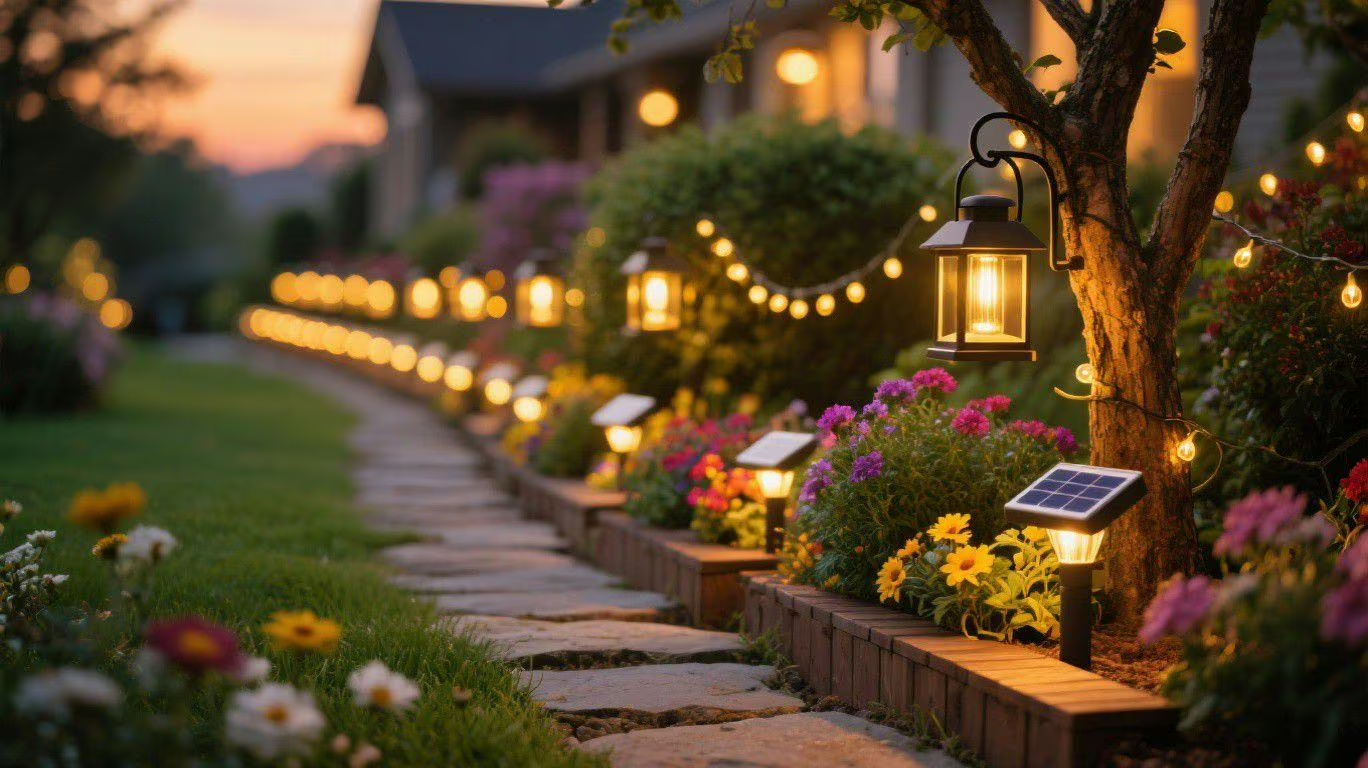
The weekend after Thanksgiving, the sun is setting before 4:30 across most of the country, and holiday lights have to carry a fourteen-hour night. That long, dark runway is exactly where the honest differences between solar and plug-in strings stop hiding. Last December I hung both on the same fence line, one section wired to an outdoor outlet, the section beside it running on solar, and watched them together for a month.
This was not a lab test. Same warm white color on both, roughly the same length, checked at the same moments every evening: dusk, the after-dinner hours, and whenever I let the dog out late. But that is the point. Solar Christmas lights brightness is not a spec sheet question. It is a what-does-the-yard-look-like-in-the-hours-people-actually-look question, and the answer changes through the night.
5 P.M.: Where Plug-In Strings Win
At dusk the wired section is at full power from the first minute, and a freshly charged solar section comes close, close enough that a driver passing at speed would never know. The real gap opens after a gray day. A wired string delivers the same output whether the sun showed up or not; a solar string that sipped from an overcast sky starts the evening a step behind. If your heart is set on a display that looks identical every single night, that consistency is the one thing wire buys you.
The catch is that nobody is looking at 5 p.m. in December. The commute crowd is driving home with headlights on and curtains closed. The brightness advantage exists mostly in hours nobody sees.
8 P.M.: The Hours That Actually Count
Between dinner and bedtime, the prime viewing window, a well-charged solar string holds its own better than the internet gives it credit for. Warm white bulbs running at full charge look rich and full, and side by side with the wired section, my wife could not reliably tell me which was which from the porch. Guests never could. This is the window your photos get taken in and the one neighbors walk past in, and it is where solar earns its keep.
What makes the difference is charge quality, not bulb count. Panels angled for low winter sun, wiped clean, and mounted out from under the eave shadow keep a string in that near-parity zone through most of the month. Sets with a decent panel and steady circuitry, like these 8-mode fairy lights, spent most evenings indistinguishable from the wired run beside them.
Midnight: The Fade You Should Plan For
Past eleven, the two sections split for good. The wired string burns flat and constant until dawn, because wall power does not run down. The solar section dims step by step, drops into a lower output, or goes dark entirely, depending on the set and the day’s charge. By 1 a.m. mine was usually down to a faint glow or off.
Whether that matters is a question about your life, not the lights. If you come home from a late shift, the fade is real and you will notice it. If the display exists for the 6-to-10 window, the midnight fade costs you nothing. Do not buy a solar display to impress an empty street at 3 a.m.
The gap also moved around with the weather in ways worth knowing. After two gray days, the solar section started its night clearly dimmer and folded early, while a fresh snow on the ground seemed to lift both sections, all that reflected light doing half the work. If your December runs cloudy, expect the wired section to win more nights than the monthly average suggests, and plan the solar sections accordingly.
Color Depth: Where the Surprises Are
The interesting results were not about raw brightness at all. Warm white is where solar performs above expectations. Warm LEDs hold their richness as the battery sags, so a fading warm string still reads golden rather than weak. Pure white is the opposite: as voltage drops, cold white bulbs go gray and thin, and a dense pure-white run starts looking like a faint outline of itself.
Multicolor strings fall in between, with one quirk. Blue is the first color to look tired, and a fading multicolor display drifts warm as the night wears on because the reds and ambers hold up. If you want a color display on solar, decorative sets with larger bulbs, like these solar decorative string lights, mask the sag far better than tiny fairy wire does.
Where Solar Simply Reads Better
There are places wire cannot gracefully go, and that is where solar is not a compromise at all. A fence 80 feet from the nearest outlet. The tree in the middle of the lawn. The mailbox, the shed, the back hedge nobody will ever run power to. Solar puts light where the yard needs it instead of where the outlets are, each string independent, so one failure never cascades. My wired section still goes dark as a whole run when one fuse blows, and the solar strings keep burning right beside it.
My split decision after a month of this: wire the one section the whole street sees from the road, if an outlet is convenient, and run solar everywhere else. For most yards the honest answer is a mix, and the fence-line experiment is cheap to run yourself. Hang both for one December weekend and you will know within three nights which sections of your yard can live on sunlight alone.