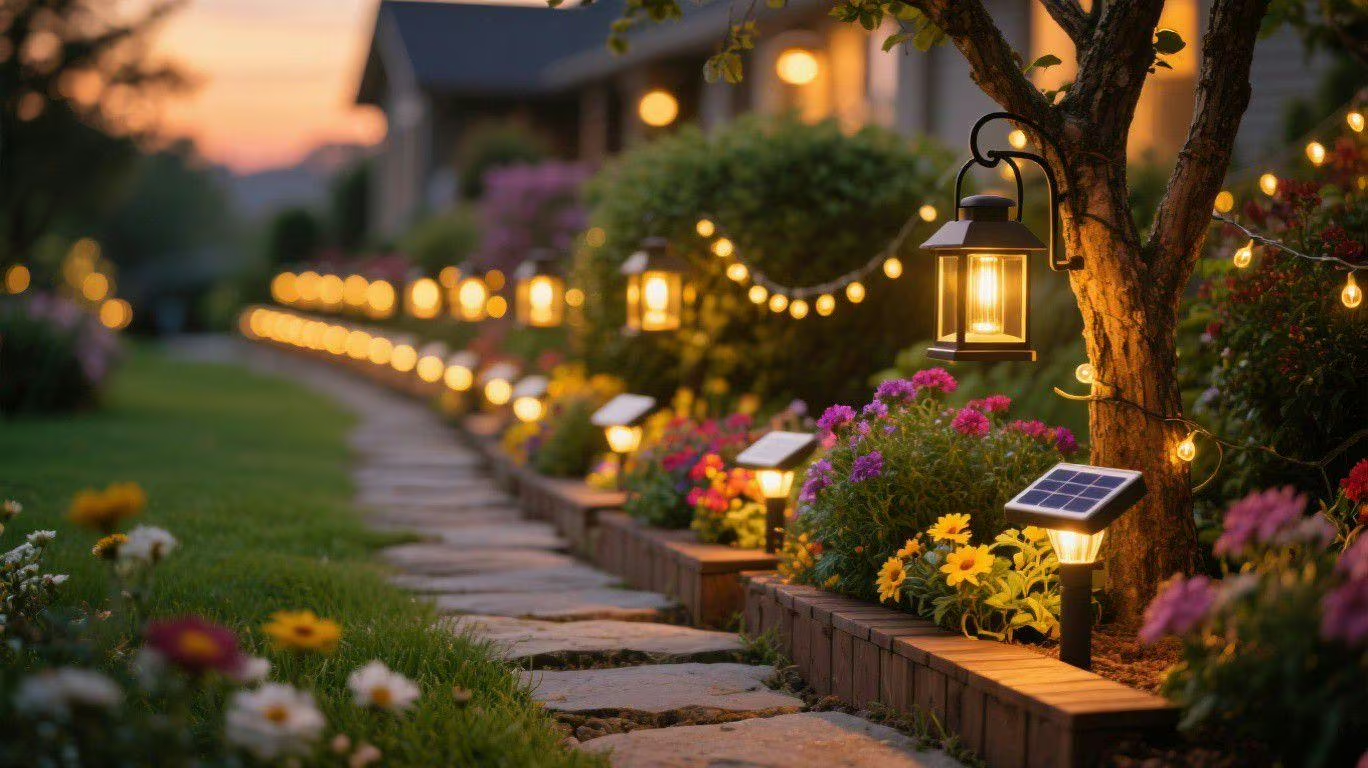
It is a few minutes past eight on an October evening. Two chairs, one blanket, a thermos, and the last gray leaving the sky. Somewhere down the block a garage door grinds open and a floodlight comes on like a verdict. That floodlight is why your corner never happens. Hygge, the Danish word the internet has thoroughly flattened, just means the feeling of a small, warm, protected place at the exact moment the world outside turns cold, and hygge outdoor lighting is the least amount of light that feeling requires.
Which is the whole trick, and why it frustrates people who try to buy it. Cozy is not coverage. A hygge corner is one pool of warm light in a deliberately dark yard, with soft things at human scale around it. Everything you add beyond that pool subtracts from the feeling, so most of this project is deciding what stays off.
Decision One: Pick One Corner and Let the Rest Go Dark
Choose the smallest usable outdoor spot you own: the corner of a patio, the side of a porch, the end of a balcony. Two chairs fit; four is a crowd. Then commit to the strangest rule in lighting: nothing else in view gets lit. The darkness beyond the pool is not the absence of hygge, it is the frame of it, the same way a campfire feels smaller and warmer against black woods than against a parking lot. If the whole yard glows evenly, no corner can feel like shelter.
Decision Two: Choose the Warmest Light You Can Find
Color temperature does the emotional work here. Light in the 1800 to 2200K range reads amber, candle-adjacent, fire-colored, and humans are wired to read fire-colored light as safe and gathered; 4000K reads as a dentist’s office by comparison. Pick the warmest fixture you can find, and if you are deciding between temperatures for the rest of the yard, our warm white versus cool white comparison shows exactly how different the same corner feels at each setting.
Brightness stays low, at reading-a-book-at-dusk levels, not find-your-keys levels. One warm white lantern-style wall light on the wall or fence behind the chairs is often the entire lighting plan, hung low so the glow lands on the seat backs and the ground rather than in anyone’s eyes.
Decision Three: Lanterns Over Candles
Real candles are the hygge prop of choice, and on a still night indoors they are perfect. Outdoors they are wind-victims, wax-factories, and open flames on wooden surfaces, which is one gust away from being the opposite of cozy. Solar lanterns deliver the identical amber flicker-feeling with no mess and no risk, and a pair of soft-glow garden lanterns on the ground or a low wall around the corner do more for the mood than any number of pillar candles you have to babysit. Cluster them at differing heights, right side of the bench, on the step, at the chair’s elbow, because layered low light at human scale is what reads as nest rather than as display.
Decision Four: Add the Non-Light Parts
Hygge is maybe twenty percent lighting and eighty percent softness. A weatherproof blanket per chair, an outdoor rug underfoot to kill the concrete feeling, a cushion with some depth to it, and a small table that holds two mugs. Add one low barrier on the open side, a bench back, a planted pot, a half-wall of some kind, and the corner suddenly feels enclosed, which is the entire psychology of shelter in one move. The light just confirms what the furniture already promised.
Decision Five: What Stays Off
Make the off-list explicit. No color-changing fixtures anywhere in view, no floodlights, no path runs marching off into the distance from the corner, because every one of those drags attention out of the pool and into the yard. If security matters, keep a motion light on the far side of the house, aimed away, where it will only ever wake up for an actual reason.
Then test it the honest way: build the corner, pour the thermos, sit for twenty minutes after full dark, and notice what you keep looking at. Whatever pulls your eyes out of the pool, kill that light next weekend. What remains, one amber glow, two chairs, a blanket doing its job, is the whole design, and it costs one fixture and the discipline to leave the rest of the yard alone.