The November forecast reads like a gift: sixty-five degrees, sunny, light wind. The almanac reads like a warning: the sun sets before five. Outdoor Thanksgiving lives in the gap between those two sentences, and the family that only checks the first one ends up eating pie in the dark.
Thanksgiving 2026 lands on Thursday, November 26, and if your crew eats outside that day, Thanksgiving outdoor lighting is the thing to get right this month. It is cheaper than the turkey and easier than the seating chart. Here is how I would layer it.
Start Overhead, Then Work Down
String lights overhead do the heavy lifting because they turn an open yard into a room. Run them above the table and the main seating, higher than head clearance and tensioned enough that wind does not swing them into the mashed potatoes. Solar string lights make this a cord-free project: the panel goes on a fence post or the garage wall where it catches sun, and the strings go where the people are. For one long table, two parallel runs beat one, because every face gets light instead of every hat brim.
Warm white is the dinner choice; cool white makes food look like evidence. If your strings offer modes, lock them on steady warm rather than twinkle, since animated light over a table reads as restlessness. And keep spare clips or zip ties in your pocket during setup, because one drooping run above the gravy is all anyone will see in the photos.
The Table Layer: Light at Face Level
Overhead light alone flattens a table and shadows every plate. Add one or two tabletop lanterns at face height, warm and dim, close enough to center that nobody stares into them across the tablecloth. Our tabletop lantern guide goes deeper on placement; the short version is small glow near the food, nothing tall enough to block conversation, and a candle-height warmth that flatters everyone at the table, including the uncle who arrived stressed.
Wind matters at face level. A tall lantern in a breeze becomes a swinging metronome, so weight the base or choose low, squat profiles. And skip real flames anywhere within reach of a tablecloth on a day when people wear coats they love.
The Path Back to the Door
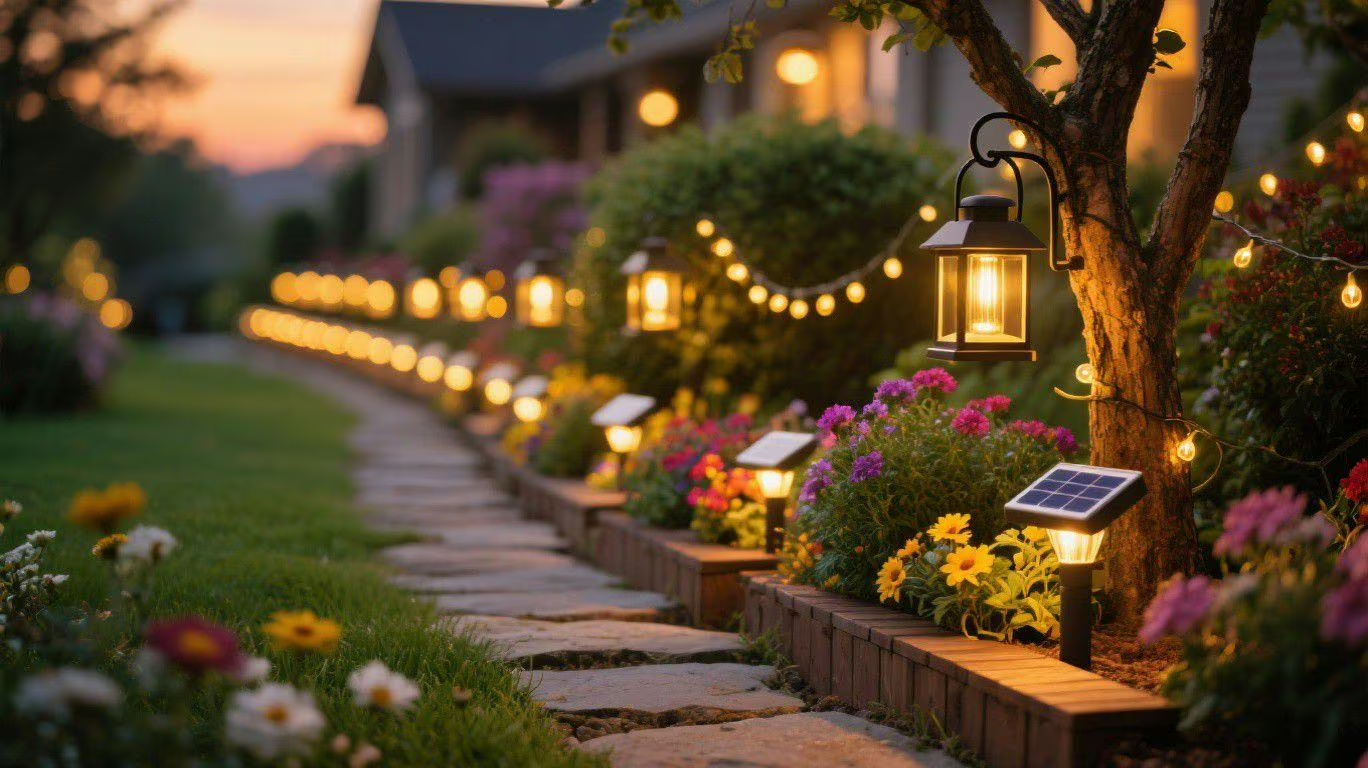
People will make the kitchen run all evening. Mark the route with a few low path lights, and put a real light at the door itself: a warm wall lantern with a motion sensor means the entry snaps bright the moment someone heads in for the third round of gravy. The trip back with full hands is the moment lighting matters most, and it is the moment nobody plans for.
Light the trip hazards directly: the step down from the patio, the hose bib someone will catch with a toe, the seam where the lawn meets the pavers. Guests do not know your yard the way you do, and they are usually carrying things and mid-conversation.
Pair the Light With the Heater Circle
If you are running patio heaters or a fire pit, draw the seating circle first and light inside it. The instinct is to light the whole yard, which spreads your glow thin and your guests thinner. Concentrate instead: strings over the circle, lanterns on the table, one or two markers on the path. The dark edge beyond is fine. It makes the lit area feel intentional and keeps everyone where the heat actually is.
A note on shadows: a single overhead source behind seated people turns every face into a silhouette. Aim for light from at least two directions at the table, which is exactly what the overhead-plus-lanterns combination buys you.
Timing So the Lights Peak at Dessert
Dessert lands around seven, and the lights need to be at their best then, which means managing charge, not just placement. The day before, clean every panel and confirm nothing is shaded by the leaf pile nobody raked. Switch fixtures to a steady mode rather than a cycling or color mode, which stretches runtime at no visual cost. On Thanksgiving afternoon, do one walk-around at four and straighten any panel that got bumped by a chair. Then stop tinkering and go set the table.
Have a backup plan for the weakest fixture: know which light you would sacrifice if the day is gray, and position it somewhere non-critical, like the far corner bed. A gray Thursday after a gray Wednesday is common enough to plan around.
One more thing: test the whole setup the weekend before, on an ordinary weeknight dinner outside. You will find the dead bulb, the sagging run, and the chair that blocks the lantern while there is still time to fix all three. That rehearsal dinner is the difference between lighting and hoping, and hoping is a poor centerpiece.