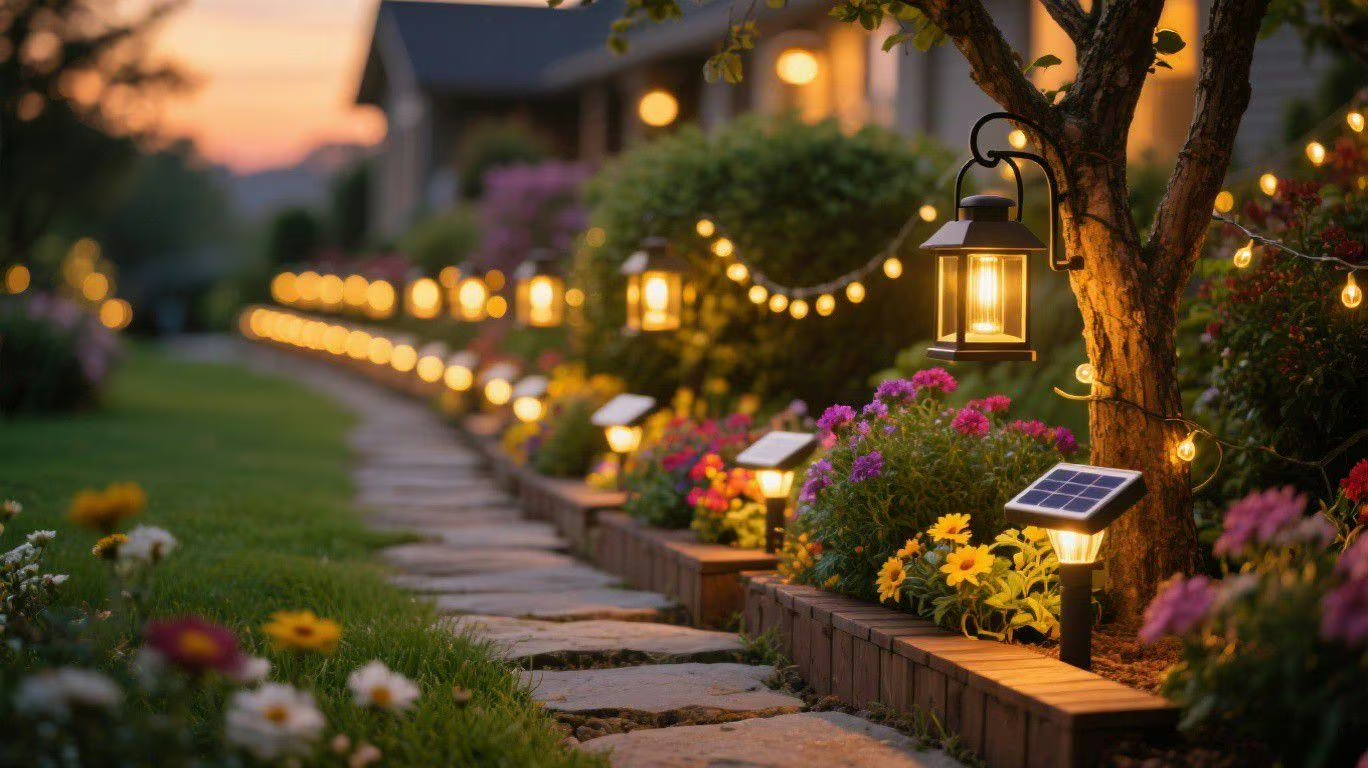
There are two kinds of well-lit yard, and they are opposites. The first is lit so a visitor never notices the dark: bright, even, security-forward, every corner accounted for. The second is lit so the sky can be seen: dim, warm, low to the ground, and deliberately incomplete. Stargazing yard lighting belongs entirely to the second kind, and that means every fixture you install either protects the night sky or spends it. There is no neutral option.
The physics is unforgiving. Your dark-adapted eye needs a good stretch of time, most estimates put it around half an hour, to see faint objects like the Milky Way or the Andromeda galaxy, and a single blue-white flood resets that adaptation in a heartbeat. So the goal is not tasteful lighting. It is the minimum light that keeps people upright on the walk, in the warmest color available, at the lowest height possible, with a way to turn the rest of it off on viewing nights.
Decision One: How Dim Can You Go
Judge every fixture by this standard: it should show the edge of a step and the line of a path, and nothing more. If you can comfortably read a book by it, it is too bright for this yard. If it casts a shadow of a person from forty feet, it is far too bright. In practice that means the smallest acceptable path fixtures, run at warm and low, with brighter output reserved for the driveway and street-facing edges where safety and neighbors genuinely come first.
Motion-activation is your friend in the tension between safety and sky. A light that wakes only when someone walks the path delivers the safety at full brightness for the ten seconds it matters and spends nothing from your night vision the rest of the evening. Put the motion fixtures where feet actually travel, and keep steady-burning fixtures as few as the household can tolerate.
Decision Two: Color, at the Warm End of the Dial
Warm light does less damage than cool light, full stop. The bluer the beam, the harder it slams your pupils and the more it scatters in the air, which is why a 6500K flood feels like an assault and a 2200K lamp barely registers. Choose the warmest color temperature you can find, 2700K at the absolute coolest, and warmer if the fixture offers it.
One trick worth stealing from the astronomy community: red light. If you already own color-changing fixtures, their red setting preserves night vision dramatically better than any white, and a cheap red headlamp is standard equipment at any star party. Red porch light on viewing nights is a look, admittedly, but it is a look with a purpose.
Decision Three: Height and Shielding
Keep every fixture below the eye line of a standing adult, because light aimed sideways at face height is exactly the light that ruins viewing. Low stake-style path lights do the job, throwing a small pool at ankle height where feet need it. Wall-mounted fixtures are acceptable only when they are the downward-shielded type: a warm white lantern wall light with motion sensing at the side door, aimed down and mounted low on the wall, gives you the safety of a bright light with almost none of the sky cost.
Wherever you have a fixture throwing light upward into the air for effect, that one has to go or get re-aimed. Uplighting a tree looks dramatic and is a viewing-night disaster, because the canopy scatters light straight into the line of sight. If tree drama matters to you, put it on the far side of the house from the viewing lawn.
Decision Four: Build a Kill-Switch Zone
The practical heart of a stargazer’s yard is separation. Split your fixtures into two groups: the front-of-house lights that stay on for the street, and the backyard viewing-zone lights that come out on clear nights. Stake lights make this easy, since pulling six fixtures and dropping them in a bin by the back door takes ninety seconds. The night you want the sky, the viewing zone goes fully dark and the front keeps just enough glow that the house does not look abandoned.
The neighbor question belongs here too. Your own discipline means little if the yard next door runs twin floods, and the honest move is a friendly conversation, not a fence you can do anything about. Lead with what they gain: fewer bugs at their own patio, since lights that stay low and warm attract fewer insects than floods pointed at the horizon. The broader case for less light, and what genuinely belongs in a yard after dark, is laid out in our piece on dark sky compliant lighting, and it makes useful reading before that conversation.
The One-Night Test
Wait for a clear, moonless night, turn the viewing zone off, and lie down on your own lawn for ten minutes. Whatever you can see after your eyes settle is your baseline, and every lighting decision from now on either defends it or erodes it. Dim the walk lights, warm the wall lights, pull the rest into the bin, and the sky over your house becomes a place you visit without driving anywhere. That is the whole quiet argument for lighting less on purpose.