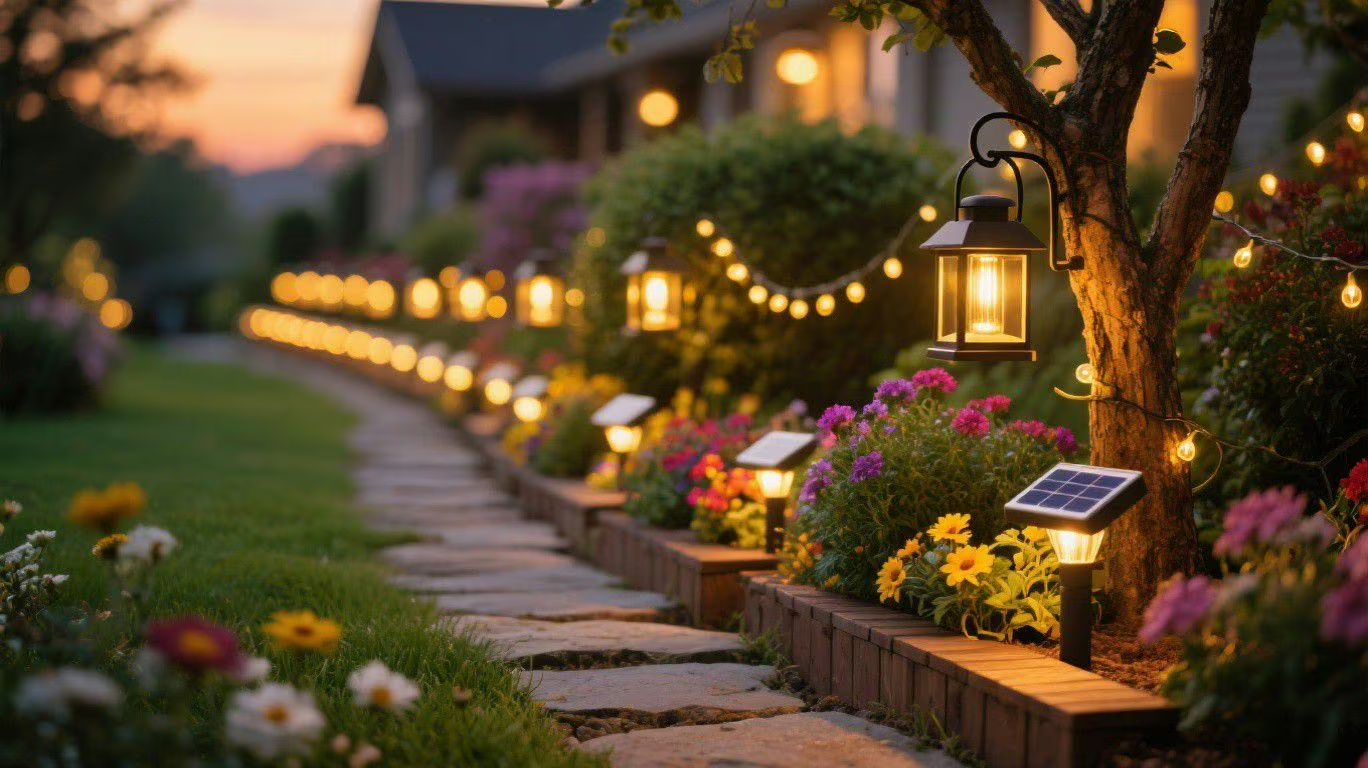
A warning before you order anything black and lantern-shaped: the fastest way to lose the farmhouse look is to buy it by label. Retail catalogs sell farmhouse fixtures by the dozen, and most of them read as farmhouse the way a trucker hat from an airport reads as ranch. The style was never a product category. It is a short formula, and if you hold to the formula you can light the whole yard from almost any decent fixture line.
The whole of farmhouse outdoor lighting comes down to five moves: matte black metal, warm white light, symmetry, honest scale, and natural textures for the accents. Here they are one at a time, with the mistakes hidden in each.
Symmetry First: Flank Everything That Matters
Farmhouse front yards are formal at the door and loose everywhere else, and the formality is symmetry. Two matching lanterns flanking the door, not one. Two matching fixtures on a double garage, mirrored. Path lights in even pairs marching to the steps. When the spacing is even and the pairs match, the house reads cared-for from the street, which is the entire emotional promise of the style. Skip symmetry at the front door and no amount of galvanized buckets will buy it back.
The same logic runs down the walk: if the path bends, the fixtures still go in pairs, and if a tree interrupts the run, the pair resumes on the far side rather than continuing as singles. Evenness reads as intention. Odd counts and drifting spacing read as whatever was on sale.
Warm White Only, and I Mean Only
The color rule is absolute: 2700K warm white or warmer, every fixture, no exceptions. One cool-white unit in a run makes the whole front yard read like a convenience store, and your eye will find it every single night. If you are torn between color temperatures, our warm white versus cool white comparison shows the difference against real siding and brick. Warm light against white board-and-batten is the single most farmhouse sentence in lighting.
Scale Like There Is a Porch Swing
Farmhouse lanterns are oversized on purpose, because the style grew out of buildings meant to be read from a field. A fixture that feels twenty percent too big in the store aisle is usually right on a farmhouse porch. Small, polite pipsqueak lanterns are the giveaway of the production-builder version of the look. A warm white lantern-style wall light beside a five-foot door should look almost slightly wrong from two feet away and completely correct from the street.
Matte Black Does the Work, Galvanized Does the Accent
Matte black is the workhorse finish because it hides sun fade, water spots, and the general punishment of a south-facing exposure. Glossy black shows every scratch and turns gray at its own schedule, so mismatched glossiness is how matching sets start drifting apart by year three. Keep the fixtures matte, then let galvanized metal carry the accents: a bucket by the step, a tub of ferns, the watering can nobody actually uses. The metal echo is the point; a matching metal set of everything is a catalog, not a yard.
A note on adding to an existing run: match the finish of the oldest fixtures, because fresh matte black will not match last year’s sun-faded gloss no matter what the box promises. Buying the whole run at once avoids the slow drift entirely.
Keep the Path Low, Even, and Boring
The walkway does not want drama. A straight run of low black solar path lights, evenly spaced, showing the edge of the walk and nothing else, is exactly right. Resist mixing shapes along one run, because three fixture styles in eight feet reads as a clearance haul. If the walk is long, spacing that feels slightly too generous at noon will look calm and deliberate at dusk, which is the only hour that matters out there.
Then run the one test that settles the whole question. Walk to the curb after full dark and look at the house the way a visitor drives up: are the door lanterns symmetric, is every light warm, does anything glow a color the others do not? Fix what fails that test, in that order, and the yard will read farmhouse without a single fixture that needed the word on the box. The formula is doing the work; the fixtures are just holding it up.