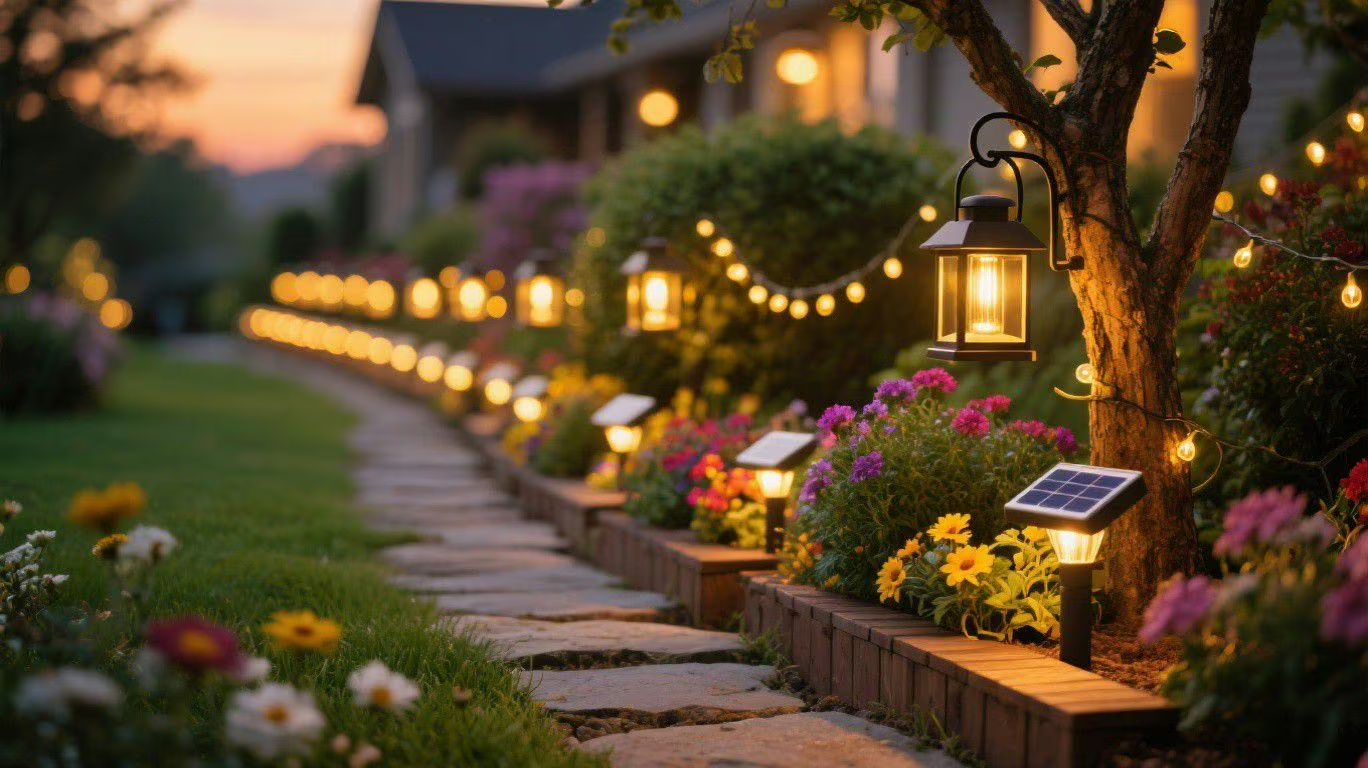
You’ve seen both failures in your own neighborhood. One house lines up path lights every four feet in a dead-straight row, and the front walk looks like a runway at a regional airport. Two doors down, three lights sit so far apart that each glows alone in its own dark lagoon, and the gaps between them are where guests trip. How far apart should path lights be? Six to ten feet is the range that looks right on almost any residential walk – and which end you choose depends on the path itself, not on how many lights came in the box.
How Far Apart Should Path Lights Be? The 6-to-10-Foot Range
Use the tight end, six to eight feet, when the path is short, curved, or genuinely hazardous – steps, a grade change, an edge people keep missing. Tighter landscape lighting spacing keeps the pools of light overlapping so the eye reads one continuous ribbon instead of separate dots. Use the wide end, eight to ten feet, when the run is long and straight, the fixtures are bright, or the budget is. Wider pathway light distance loses some ribbon effect but dodges the airport look – which is what happens when even spacing meets identical fixtures on a straight line. If you take one thing from this piece, take this: uniformity is the enemy. Metronome-even spacing with matching lights is exactly how runways happen.
Straight Runs vs Curves
Straight walks read as formal, so they tolerate – and honestly need – slightly wider solar path light spacing to keep from going rigid. Curves are easier: place the lights on the outside of the arc so they trace the turn, tighten the spacing a touch through the bend, and let the geometry do the work. A curved path with well-placed outside lights feels designed at almost any spacing. The mistakes are mirror images: straight runs spaced too tight look militaristic, and curves spaced too wide look like an afterthought.
Fixture brightness plays into this more than people expect. A modest path light that throws a soft three-to-four-foot pool needs closer spacing or the pools never touch, and you get the lonely-lighthouse effect. A brighter head can sit at the wide end and still read as one continuous line. If you already own the lights, the fixtures make half the decision for you – space dim ones tighter and bright ones wider, and let the overlap, not the tape measure, be the judge.
Wide Walkways: Stagger, Don’t Double
If your walk is five or six feet across, the instinct is a matched row down each side. That doubles your fixture count, doubles your charging problems, and reads as a fence rather than a path. Stagger instead: single lights alternating left and right in a gentle zigzag, still six to ten feet apart measured along the walk. You get full coverage from half the fixtures, and the offset rhythm looks intentional instead of inherited. Save true symmetry for the bookends – a matched pair flanking the start of the walk and the base of the porch steps – where formality actually earns its keep.
How Many Path Lights Do I Need? The Math
One line of arithmetic: path length in feet, divided by spacing in feet, plus one for the starting light. A 48-foot front walk at 8-foot spacing wants about seven lights. A 20-foot side path at 6 feet wants four. Steps count separately – stair lighting is its own product category with its own rules, and no amount of path lighting rescues an unlit step. Run the numbers twice before you order, once at each end of the range, because that spread – six lights versus eight on the same walk – is the exact decision you’re making at checkout.
One more real-world wrinkle: solar changes the cost of getting the count wrong, in your favor. Buy four, discover you need six, and the fix is a two-pack and ten minutes – no trenching, no transformer capacity, no electrician. That’s the quiet argument for starting at the wide end of the spacing range with fewer fixtures and letting your own yard vote on the additions. Wired landscape lighting forgives nothing; solar forgives almost everything except deep shade.
Start Sparse, Add Later
The final rule, and the one I’ve never regretted: install fewer lights than you think you need, live with them a week, then add. Solar makes this cheap – moving a stake light costs thirty seconds, where moving a wired fixture costs a trench. Dense is hard to walk back; sparse is a Tuesday errand. Aim every addition at a real dark gap you’ve physically walked into, not at symmetry. For the broader logic of what goes where, I wrote a zone-by-zone placement guide, the no-trip installation guide covers the safety end, and the pathway lights we stock come in pack sizes built for exactly this start-small approach.
Mark It at Dusk, Not on Paper
Here’s the closing move. Don’t commit to spacing on a sketch. Set the lights out unlit at dusk, walk the path like a first-time guest, and chalk-mark where the dark gaps actually fall. Install at those marks. The math gets you close; your own feet at night get it right.