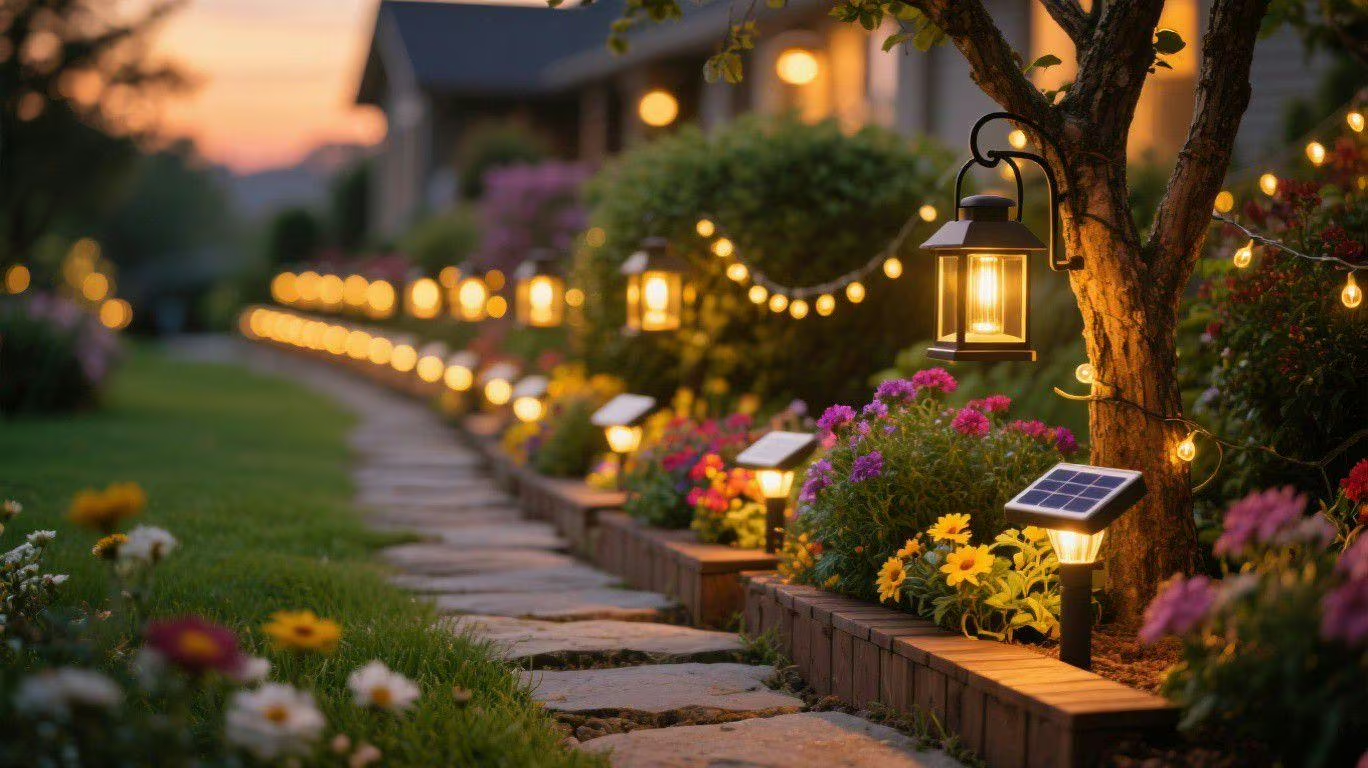
Some yards have expensive lighting and still look cheap. The fixtures cost plenty, the lights come on at dusk, and something reads off anyway. When people ask me why their landscape lighting looks bad, it’s almost never the equipment. After a decade of installing and fixing other people’s garden lighting mistakes, I can tell you the usual suspects are the same seven, and every one of them takes an evening to fix.
The Seven Garden Lighting Mistakes I See Most
- Parking-lot brightness. If your yard reads like a convenience store lot at 9 p.m., you’ve bought lumens instead of a plan. Fix: cut the fixture count in half and aim what’s left at things, not at the sky.
- Mixed color temperatures. Warm white next to daylight blue in the same view looks like two different installs from two different decades. Fix: pick one temperature, and I’d argue for warm, then stick to it everywhere.
- The runway. Path lights spaced with a tape measure, dead equal down both sides of the walk. It reads as approach lighting. Fix: break the rhythm, use odd numbers, and let a stretch of lawn go dark on purpose.
- Everything at ankle height. A yard of nothing but path lights has one layer, and one layer is a hallway. Fix: add one wall light or one spot on a tree and the yard gains a middle and a top.
- Bare bulbs at eye level. A lens aimed at the patio turns every conversation into a squint. Fix: aim lights down or away from seating, or shield them, and your yard doubles in perceived size.
- Fixtures that look worse at noon. The lights are on for six hours and visible for twenty-four. Glossy plastic mock-lanterns photograph badly in daylight. Fix: hide stakes behind plants and choose simple matte housings that disappear.
- Hang and forget. Batteries fade, shrubs swallow fixtures, stakes tilt. A lighting plan with no maintenance date is a plan that expires. Fix: two walk-arounds a year, spring and fall, and fresh batteries when runtime drops.
The Runway Effect, and the Fix That Isn’t Obvious
The runway deserves its own paragraph because it’s the most common landscape lighting mistake and the easiest to internalize wrong. The instinct is to fix it by spacing lights even farther apart. That just builds a longer runway. What breaks the effect is irregularity: vary the gaps between fixtures, skip the stretch where there’s nothing worth seeing, and cluster three lights around one good tree instead of marching six down a path. Your eye forgives a missing light. It never forgives a perfect grid.
Glare Is the Mistake That Gets You Complained About
Brightness aimed at eye level is the one mistake that travels past your property line. I’ve watched fixtures from across a cul-de-sac light up a neighbor’s living room, and nobody enjoys that. The test is simple: sit where you actually sit at night and look around. If you can see a bulb, that fixture is aimed at a face. When I tested glare from solar lights against the neighbors’ view, the cheap fix was almost always tilting the head a few degrees or stepping the fixture back into a planting bed.
The fix has an order to it, and buying new equipment is last: aim the light somewhere else, shield it, lower it, or remove it entirely. Most glare complaints I get called about end with a five-degree twist of a fixture head and nothing gets replaced at all. That’s the pattern worth noticing across this whole list. The mistakes are almost never about money spent. They’re about where the light points, how warm it burns, and how evenly the yard breathes between bright spots.
Judge the Yard at Noon, Too
Night is only half the life of a lighting install. At noon, chunky glossy housings, trailing wires, and fixtures floating in bare mulch are the whole show. This is where the better garden lighting ideas usually earn their money quietly: matte black or dark green stakes that vanish against soil, heads tucked behind a low shrub, and wire routed behind a stem instead of across the lawn. If a fixture looks planted rather than dropped, it will look expensive at any hour.
My One-Evening Walk-Around Checklist
- Stand at the sidewalk and look at the house the way a visitor does. Count the bulbs you can see directly. That number should be close to zero.
- Sit in your main seating area and repeat the squint test from there.
- Check the temperature story: every light in view should read the same warm tone.
- Count total lumens, not fixtures. If you’re unsure how much light a yard actually needs, read up on lumens versus watts before buying anything else.
- Walk the property line and look back at your house from the neighbor’s driveway.
- Put a spring and fall walk-around on the calendar right now, batteries and re-aiming included.
Most of these outdoor lighting tips bend in one direction: less light, aimed better, in one color. If you want a target to aim at, spend some time with the moon garden approach. It’s the opposite of the runway, and it’s the look people stop their cars for. Start with the mistake that bugs you most tonight, fix that one, and leave the rest for the weekend.