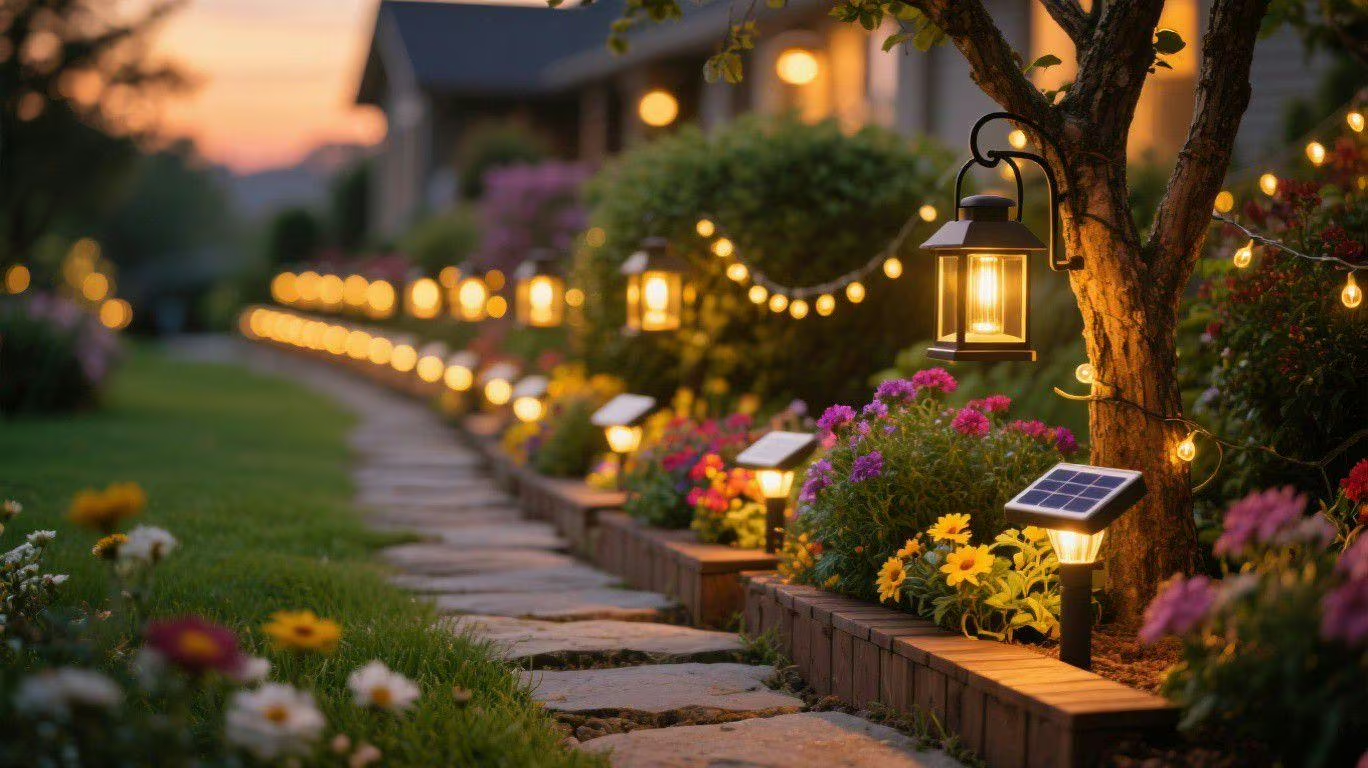
Every June the same scene plays out on my porch: one light on, thirty moths in formation around it, and by mid-July a spider has built a web in the corner directly underneath, running a very profitable little restaurant. So do outdoor lights attract bugs? Yes – but the power source has nothing to do with it. Insects do not know or care whether your fixture is solar, wired, or battery powered. What draws them is the color of the light, and that is a spec you can choose.
Here is why insects spiral around lamps in the first place, what that means for the bulbs you buy, and the three changes that cut my own porch swarm down to almost nothing.
So, Do Outdoor Lights Attract Bugs? Only Certain Light
Why do insects fly at lights in the first place? The leading explanation is navigation: many insects hold a fixed angle to something bright in order to fly a straight line, which works beautifully with the moon and fails catastrophically with a porch bulb fifty feet away – keeping a constant angle to a nearby light produces a spiral, straight into the fixture. Which lights pull them in hardest comes down to wavelength. Insects are strongly drawn to short wavelengths – ultraviolet and blue – and largely ignore long wavelengths like amber and red. That is why bug zappers lure with UV tubes, why the insects at your porch light are mostly at the cool-white fixture and not the amber one, and why the question is never solar versus wired. Color temperature is the whole game.
There is a fun parallel here: solar panels also respond to wavelength rather than to brightness alone, which is how panels see the spectrum – different physics, same lesson. Wavelength is a specification, not a mood.
Warm Light Wins, and the Version to Buy
For the warm light vs bugs question, the practical line is 2700K and below. Warm white and soft white LEDs in that range sit at the long-wavelength end of white light, and in my experience they draw noticeably smaller crowds than 5000K daylight fixtures hanging in the same yard. The classic yellow bug lights take the idea one step further, trading white for amber entirely – they do not eliminate insects, nothing does, but they cut the draw sharply while still lighting a porch well enough to eat dinner by. When you shop, check the color temperature on the box rather than the picture on the front, and if you want fixtures whose warm glow actually flatters the wall behind them, the observations in color accuracy testing for solar lights are worth ten minutes.
Three Changes That Thin the Swarm
- Drop the color temperature. Swap cool-white fixtures at seating height for 2700K warm white or amber. Same fixture, same mounting, smaller crowd – this is the single highest-impact change.
- Drop the lumens. Fewer photons is a smaller beacon. A porch needs enough light to find the door and the burger, not enough to land a Cessna; if you are unsure how much is enough, less than you think is usually right for seating areas.
- Move the light off the people. Keep the brightest fixture at the perimeter – a post light at the steps, a sconce on the garage – and let the seating area run dimmer. Insects collect at the beacon, so put the beacon where you are not. The pattern-throwing mandala wall light on my fence corner is the perfect example: warm, modest output, aimed at a surface fifteen feet from the table, interesting to look at and boring to a moth.
The Spider Web Economy
Once you understand what color light attracts fewer bugs, you get a free diagnostic tool: spider webs. Spiders build where the food is, and the food is at your brightest, coolest fixture. A web packed into the corner under the porch light means that light is running a bug buffet. After I switched the porch to warm white and moved the bright fixture to the gate post, the web moved to the gate post too, and the porch corner stayed empty all summer. Nature keeps honest books.
Do bug zappers actually work?
Against moths and beetles, yes, enthusiastically. Against mosquitoes, the insect you actually care about, barely at all – mosquitoes find you by carbon dioxide and body heat, not by light, so a zapper kills the harmless crowd while the biting crowd keeps finding your ankles. Worse, a UV zapper next to the seating area advertises your patio to every insect in range. If you own one, move it to the far corner of the yard and let it work on the perimeter.
What color light attracts the fewest bugs?
Amber and yellow, roughly the 2000K to 2700K range, followed by warm white. Red attracts even fewer insects, but a red porch reads like a darkroom and flatters nobody, so amber is the practical winner. The colors to avoid near seating are the cool blues: 5000K daylight and anything marketed as bright white, plus any fixture with a visible blue or violet tint.
Start with the swap that takes ninety seconds: one warm-white bulb in the fixture nearest where you sit. Give it a week and count the difference under the light. Then take the same thinking to the rest of the yard, because a perimeter that glows amber instead of blue-white is quieter in every sense.