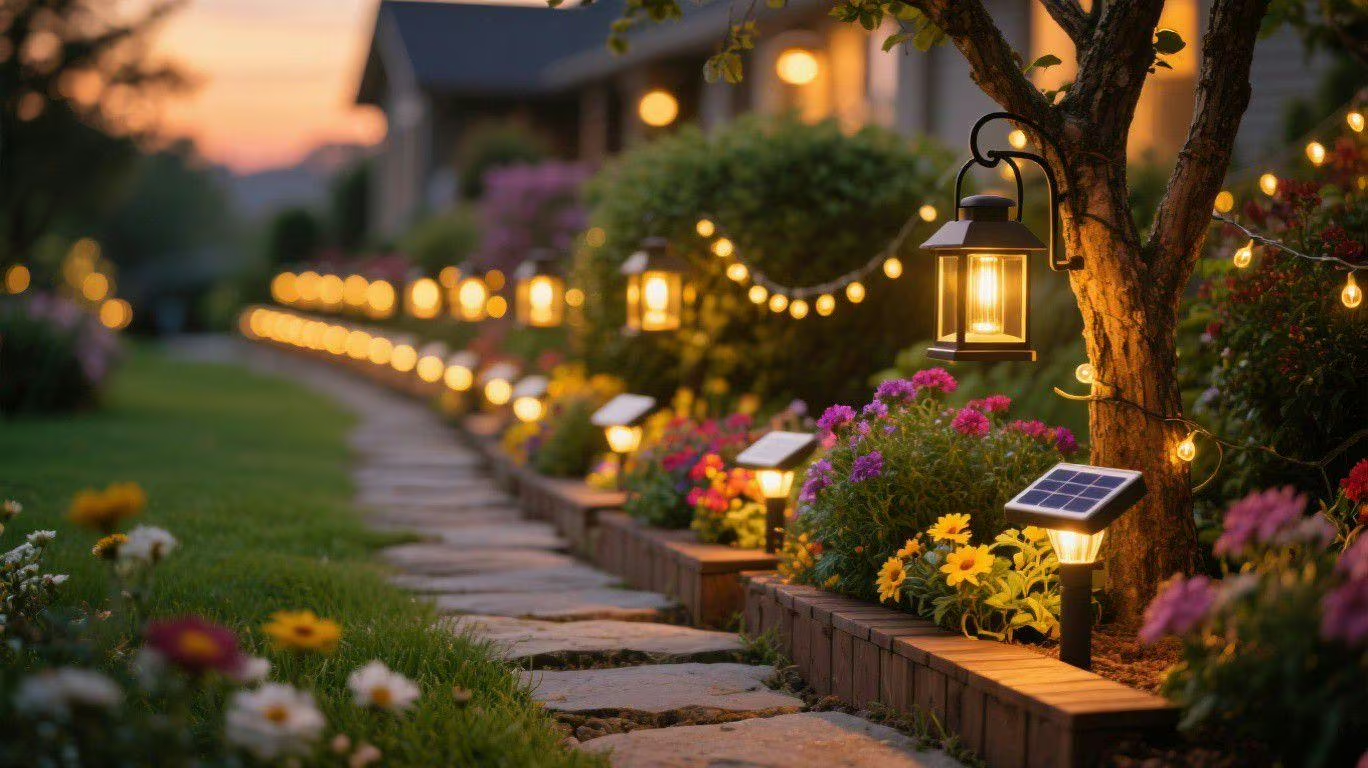
My brother-in-law bought color changing solar lights for his front walk two summers ago and called me in October convinced something was broken. The lights cycled. Red, green, blue, back to red, all night, every night, reflecting off his white porch columns like a drive-through sign at midnight. Nothing was broken. Every fixture was doing exactly what its mode button told it to, which was the actual problem. We spent ten minutes with the remotes, locked everything to warm white, and his wife started speaking to him again.
That call captures the whole category. Color changing solar lights are neither good nor bad; they are powerful, and power without a setting reads as chaos. Where they belong and where they do not is a short list.
The dividing line is public versus private. Anything the whole street watches wants steadiness. Anything only your household and your guests see can play.
Brightness deserves a sentence too. Color modes on budget fixtures often run noticeably dimmer than their steady warm white mode, because driving three LED colors at once splits the power three ways. That is not a defect, and it is actually useful: it means a color wash can sit closer to seating than a white flood could without turning the area into a stage. Read it as a feature, plan around it, and stop expecting color mode to light a path.
Where Color Changing Solar Lights Earn Their Keep
- Holiday overlays. This is the killer app. One fixture handles July’s red-white-blue, Halloween purple, December’s red and green, and game-day colors, all from a mode press. You buy once and skip an entire closet of seasonal decor.
- Kids’ zones. A play corner, a treehouse approach, a backyard fort. A slow color wash across a fence is exactly the point there, and no guest is trying to read a house number through it.
- Party corners. The patio bar, the fire pit seating, anywhere a gathering runs past ten. A projection light cycling slowly on a fence turns a corner of the yard into the party without a single extension cord.
Where They Read Wrong
Front walks, entries, and anywhere a stranger decides whether your house is approachable. Steady warm white at an entry says come in. A slow rainbow at an entry says we sell tacos. The front-of-house job is legibility: path, steps, door, house numbers. Color belongs behind the house where the household plays, not out front where the world walks by, and that split is the single highest-leverage decision in this whole article.
There is also a legibility cost nobody prices in. Color wash makes house numbers, step edges, and path curves harder to read, because the eye spends its attention decoding the hue instead of the ground. Warm white at an entry does the opposite: it disappears as light and leaves only the thing it illuminates. Color behind the house, function in front.
The street has opinions, and it is worth remembering that you share the view. A neighbor fifty feet away sees your cycling fence wash as the dominant feature of their own dark yard, whether they want to or not. Before committing color to anything visible from the road, stand in their driveway one evening and look back at your house. It is the fastest perspective check in outdoor lighting, and it has saved more than one block relationship.
Modes Are Manners
The etiquette is simple. Lock colors instead of letting them drift: one steady color for a theme night, slow cycle only during a party, warm white as the default the other fifty weeks a year. If your fixtures keep sticking on a single color mid-cycle, that is usually a battery or remote sync issue rather than a mood choice, and the RGB stuck-on-one-color fix walks through it. And keep flash and strobe modes off residential streets entirely. Strobing belongs at a middle school dance, not a cul-de-sac.
One boundary that helps with kids and color: put the decision on a schedule rather than up for debate. Our niece-and-nephew rule is that color happens on request but resets to warm white at bedtime, and after a week nobody noticed the reset anymore. Structure is what keeps a color-capable fixture feeling like a lighting choice instead of a toy that happens to be bolted to the fence.
The pattern that works, and the one my brother-in-law runs now: warm white string lights on the front walk year-round, with one color-capable strand looped into the porch rail that comes out for holidays and disappears in November. Their kids now request specific colors on specific days, which was not the plan, but nobody is complaining. His wife’s review of the new arrangement was that the lights are, quote, fine now. From her, that is a rave.