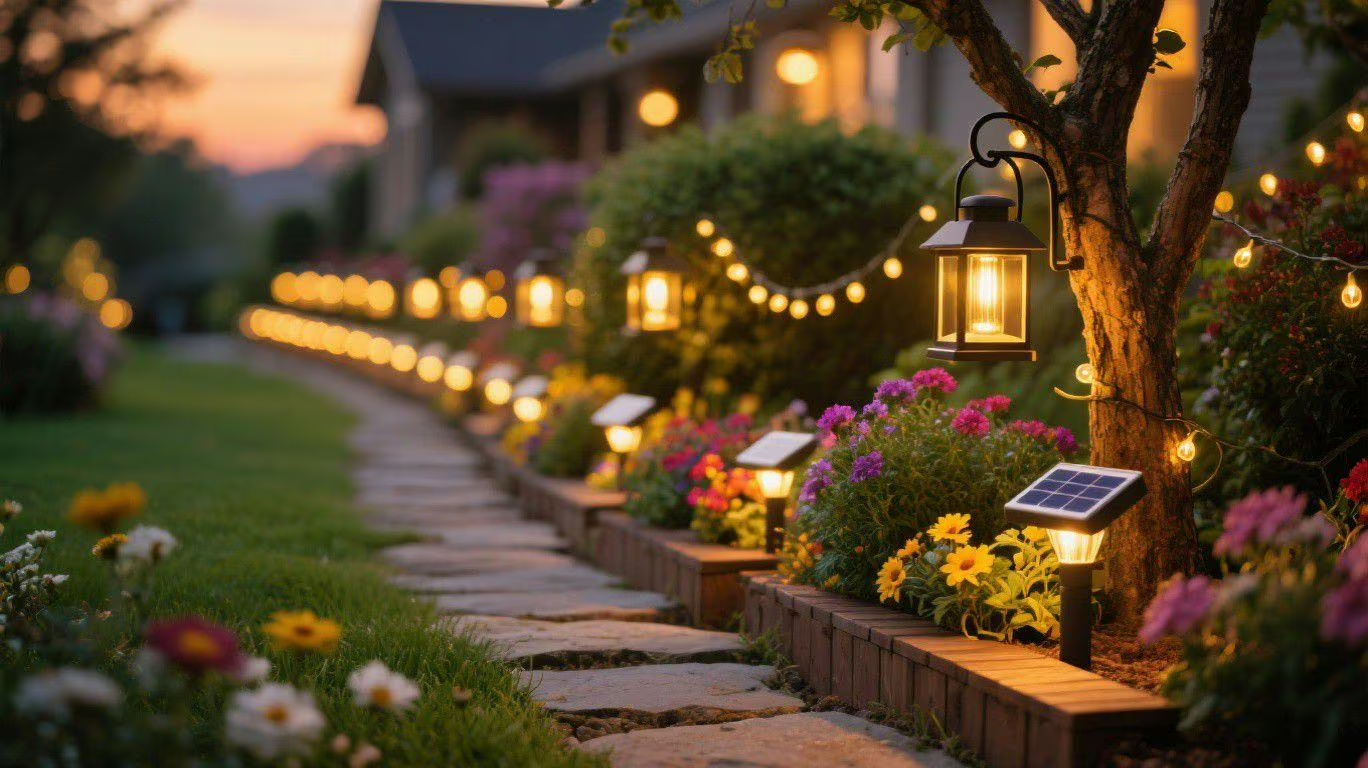
The best string-light yard on my block has exactly zero trees. I noticed this from the alley in September: two strands crossing a small patio in a lazy X, hung nearly level, no visible poles, no drooping cords, no leaning scarecrow posts. For a year I had assumed the display leaned on the big maple out front. It did not. The owner had solved hanging string lights without trees using two steel posts, three weighted planters, and a length of guide wire, all for less than a nice dinner. I went home and copied the arrangement that weekend.
The observation that stuck with me is that treeless yards are not a string light problem. They are a charging advantage. Every tree you might hang from throws shade across the very panel that has to feed the strand, drops sap on the bulbs, and releases branches during the first decent storm. Open sky overhead is what solar strings want anyway. The only real problem to solve is the anchor, and there are three ways to build one.
Three Ways to Hang String Lights Without Trees
Pick by budget and by how permanent you want the result. All three carry the same physics lesson: strand alone, expect sag. Any span past about twelve feet will droop visibly unless the lights hang from something that does not stretch, which is what the guide wire in build two is for.
Build One: Poles in Weighted Planters
The cheapest and fastest. You need two or more poles, planters heavy enough to keep them upright, and something to ballast with.
- Poles: an eight-foot 4×4, or a metal deck post, capped with a cup hook or an eye bolt near the top.
- Planters: twelve to sixteen inches across, filled with gravel or a bag of quick-set concrete for permanent weight.
- Placement: set the planters where you want light pools, not necessarily at the run’s ends; people sit under the strands, so aim the X over the seating.
- Solar note: keep at least one pole where it gets sun; strands with a stake panel give you freedom to place the panel separately from the anchors.
Before you buy planters for build one, check the wind. A weighted pole planter is stable until a fall gust catches six feet of pole and a strand like a sail, so if your yard funnels wind between houses, add weight generously or move up to build three. My rule after one tipped planter and a drinkable evening cut short: if the planter is light enough to carry with one hand, it is light enough to tip.
Build Two: A Guide-Wire Span From the Fascia
For longer spans, hang the lights from steel cable instead of their own string. Screw an eye bolt into the fascia or a corner post, run cable to a pole or another wall, add a turnbuckle to take out slack, then clip the light strand to the cable with small zip ties every foot or two. The cable holds the line; the strand just decorates it. The same logic applies under a structure: if you have a pergola, the pergola string light setup covers rails, beams, and panel placement in detail.
Build Three: Posts Set in Concrete, for Keeps
Two 4x4s in post holes, cut to nine or ten feet, capped and stained, will outlast several generations of string lights. This is the version to build if you have decided the patio is permanent. Set them a few feet beyond the seating on each side, hang the strand between with slack to spare, and plant something climbing at the base so the posts earn their garden real estate.
Keep the Panels Honest, Whatever You Build
Solar strands differ in one way that matters to anchors: fairy-style solar string lights usually carry a small panel on a stake or on the first bulb, and decorative solar strands often split the panel off on a cable. Whichever you own, give the panel the sunniest end of the run and angle it toward the open sky, then wipe it monthly. A strand hung beautifully in the shade of your own arrangement is a strand that quits by eight, and no anchor fixes that.
Height is the other quiet advantage of building your own anchors. Tree branches force strands wherever the branches happen to be, which is often too low to walk under or too high to feel intimate. Your own poles sit at whatever height the seating wants, which for most patios means the strand hangs between seven and eight feet: high enough to clear heads and pitcher arms, low enough that the glow still lands on the table.
Start with one span, one afternoon, two planters and a pole. Live under it for a month before you build the full grid. The upgrade path is always there, and the first span teaches you more about where your yard actually gathers at night than any sketch will.